
Navarro County Projected vs Actual Release
TDCJ uses the label Projected Release Date where a public offender detail supplies one. It reflects sentence administration at that moment. The maximum sentence date is generally the calendar endpoint after sentence and credited-time calculations. Parole eligibility is the first point at which the law permits consideration. Neither eligibility nor a favorable vote is a release.
A pretrial detainee has no sentence-based projected date. Bond, dismissal, a court order, holds, and administrative processing determine when that person can leave. The public roster may show a bond setting, but that does not prove it was posted or that another hold was cleared.
How to Find a Navarro County Projected Release Date
- Check the official NCSO roster gateway for current county custody. If the person is absent, check released mode and request the custody-ending event.
- For a TDCJ sentence, search the official offender-information system with the TDCJ or SID number when available. Compare identity, conviction county, status, location, and dates.
- Read each field separately. Do not convert eligibility, a vote code, or a maximum date into a promised departure day.
- For a county-only sentence, obtain the judgment, jail-credit order, and county computation from the court and NCSO. TDCJ's public projected field does not calculate a county term.
- After the expected date, confirm the actual event with the custodian. Determine whether it was community release, transfer, or another hold.
The TDCJ offender-information guide is represented in the successful project capture. Visit the official TDCJ offender-information page for the current search route.
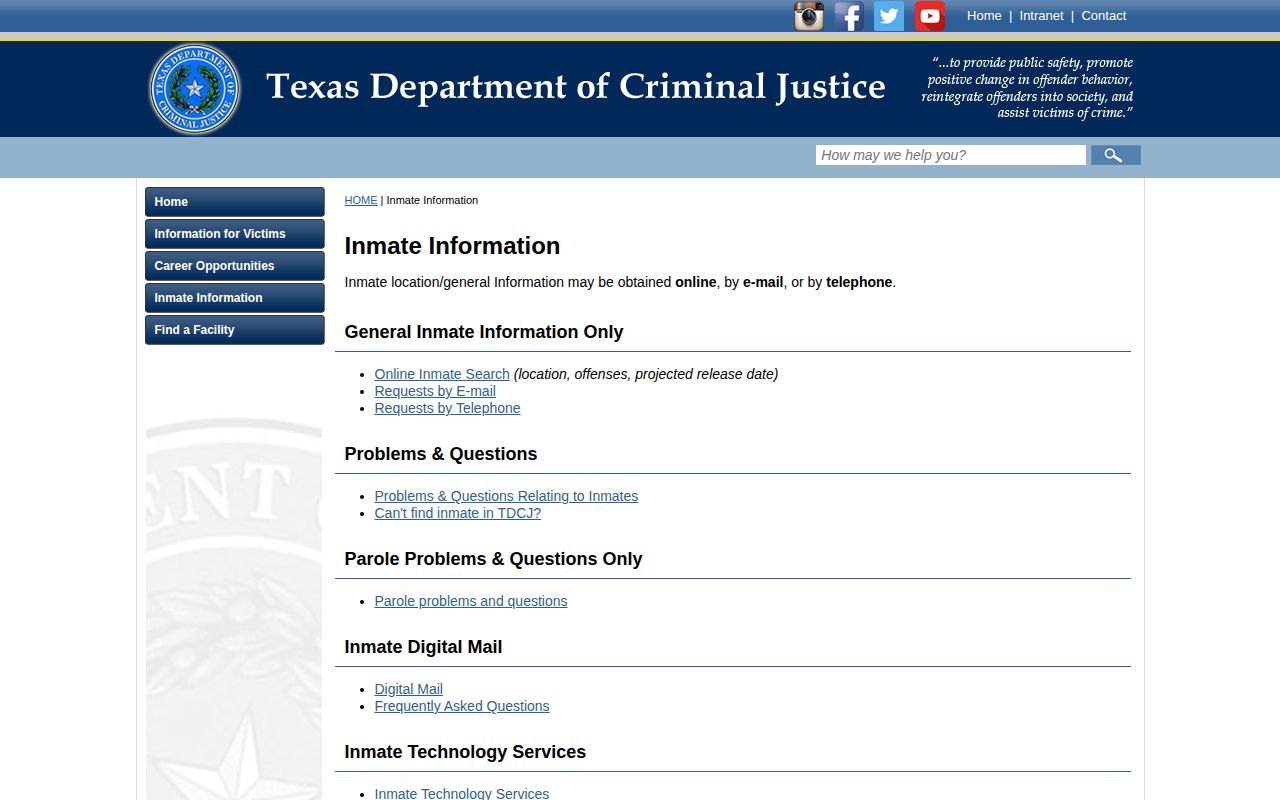
The guide is the state path for sentenced prisoners; it does not replace NCSO or court records for a county-only term.
Texas Good Conduct Time in a Navarro Release Calculation
Texas good conduct time is governed principally by Government Code chapter 498. Credits may affect eligibility calculations under the law that applies to the conviction, but they do not reduce every sentence day for day. Credits may be earned, forfeited, or restored, and Texas law limits their effect. Parole eligibility is offense- and date-specific under Government Code chapter 508. Mandatory-supervision exclusions appear in section 508.149.
The sentence, offense date, judgment date, deadly-weapon finding, jail credit, concurrent or consecutive structure, and release mechanism all matter. That is why an online date is best treated as an agency calculation, not a do-it-yourself arithmetic result. Corrected judgments or newly posted credit can change the display without any new criminal conduct.
Why a Navarro County Projected Release Date Changes
| Change | Effect on the record |
|---|---|
| Corrected judgment or jail credit | TDCJ recalculates from the controlling court material. |
| Good-conduct time | Earned, forfeited, or restored credit can affect calculations where law permits. |
| New sentence | Concurrent or consecutive terms may alter the endpoint. |
| Parole decision | Eligibility permits review; the decision and prerequisites determine whether release proceeds. |
| Mandatory supervision | Statutory eligibility and exclusions affect the applicable path. |
| Detainer or hold | One custodian may release the person directly to another. |
Temporary portal delays can also make two official screens disagree. Preserve the date observed, then confirm with Classification and Records or the custodian rather than selecting the more favorable result.
Confirm a Navarro County Release Event
Texas IVSS-Counties can provide custody notifications, while the separate TDCJ IVSS covers state prison and parole events. An alert is useful notice but not the official record. If an alert arrives and the county released detail lacks a clear release time or reason, preserve the alert and request the NCSO custody ledger. Ask whether the event was bond, own-recognizance or pretrial release, time served, court-directed release, or transfer.
Compare the booking number and admission date if current and released results both appear. A person can have an older released booking and a newer active one. For a precise statement, pair NCSO's custody-ending entry with the related court order or TDCJ admission. The VINELink Inmate Search page explains the notification boundary.
Does Texas Require Navarro Inmates to Serve 85 Percent?
No universal Texas 85-percent rule applies to every conviction. Some readers import that figure from federal practice or another state's truth-in-sentencing system. Texas calculations vary with the offense and date. For certain serious cases associated with Article 42A.054 or an affirmative finding, section 508.145 commonly uses one-half of the sentence in actual calendar time or 30 years, whichever is less, for parole eligibility. Other cases can use calendar time plus good conduct time equaling one-fourth of the sentence or 15 years, subject to the statute.
Those are eligibility calculations, not promises of release. A person may be reviewed and denied, have prerequisites outstanding, or remain subject to another hold. Use the current official statute and ask TDCJ to confirm the individual computation.
County Jail Dates Are Not TDCJ Dates
A sentence served only in Navarro County is controlled by the court's judgment, the jail-credit order, and the county custody calculation. Bond, dismissal, and transfer are not earned-time releases. NCSO has not published a fixed release-hour schedule or universal weekend-processing rule, so call the 24-hour jail line for logistics and obtain the booking-specific record after departure.
NCSO identifies own recognizance, the Pre-Trial Release Program, private bonding company, property bond, and cash bond as local release mechanisms. A released detail may display bond amount or type, but the display does not establish which mechanism completed release. Court paperwork, another jurisdiction's hold, identity verification, and administrative processing can intervene. Ask for the custody-ending code and its description instead of reverse-engineering the event from the bond column.
Requesting Navarro County Date Records
For a completed county event, request the booking sheet, public custody-event history, date and time county custody ended, public release or transfer code and description, receiving agency if public, and the bond or release authority. Identify the booking number and approximate admission date, request electronic production, permit lawful redaction, and ask for an estimate before charges exceed a chosen limit. NCSO accepts written requests through its published records email, fax, mail, or delivery channels.
For state information, TDCJ says general offender information may be requested by email with the full name and seven-digit TDCJ number. If the number is unknown, exact birth date or approximate age and county of conviction can help. That route may provide incarceration history and a projected date, but a fuller certified or photograph-bearing record belongs in the formal public-information process. A precise request reduces mistaken identity and retrieval cost.
Federal and Immigration Release Dates
A federal or immigration hold requires a separate lookup. The BOP locator covers federal prisoners in its historical range, labels completed results “RELEASED,” updates daily, and warns that sentence recalculations may affect projected dates. A BOP miss proves little for a USMS pretrial detainee because USMS often uses state, local, or contract facilities. Use the federal docket and custodian confirmation.
ICE ODLS covers current detainees and certain people released from ICE custody within a recent window. A county departure can therefore coexist with immediate ICE custody. After the ODLS released-person window closes, absence is weak evidence about earlier detention. Record each custodian's event separately and avoid describing transfer as freedom.
Reading Texas Parole Dates and Vote Results
A parole review introduces several dates that should not be collapsed into one. Eligibility is when the governing law permits review. A review date concerns agency processing. A vote describes the panel's decision, and some favorable vote types require a program, residence plan, or other prerequisite. Scheduled release information remains subject to sentence administration and holds. Only an actual TDCJ release entry establishes that state confinement ended.
Texas does not use a county-style public calendar of formal release hearings for ordinary parole consideration. Three-member panels review files sequentially. This differs from administrative revocation hearings for people already under supervision, which may occur in county jails. A hearing reference therefore must be read in context before anyone assumes it is a release hearing or predicts a departure date.
If the person has an approved residence in Navarro County, the release plan may connect to Parole Division supervision. That address or office assignment does not change the underlying calculation and should not be treated as proof the person has left the institution. Confirm the actual release and assigned office through the release papers or TDCJ.
Cross-Checking a Navarro County Release Projection
For a county bond release, use the NCSO released entry, the sheriff custody ledger or release code, and the relevant bond or court instrument. TDCJ ordinarily adds nothing unless a state hold or sentence is involved. For time served in the county jail, pair the actual NCSO custody-ending entry with the signed judgment and credited time. A public TDCJ projection does not calculate that county-only term.
For transfer to TDCJ, pair the NCSO transfer event with state admission and location. This shows release from the county facility but continued incarceration. For parole or mandatory supervision, combine TDCJ actual or scheduled information, parole-decision context, and state notification or Parole Division confirmation. Eligibility alone is insufficient. For dismissal, the signed dismissal proves the case result while NCSO establishes when physical custody ended and whether another hold intervened.
Each source has a time boundary. Navarro's released search does not promise a maximum archive period or update cadence. TDCJ can recalculate its displayed date. BOP says its locator updates daily, while ICE released-person results cover only a limited recent period. Record when each search was performed and preserve identifiers so later changes can be explained.
Identity Checks Before Trusting a Release Date
A common name is not enough for a projected-date claim. Compare the Navarro booking number, TDCJ number, SID, birth information where lawfully displayed, conviction county, offense, admission date, and current location. If a county released result and current result both match the name, compare booking numbers because an older completed booking may coexist with a newer active one.
Dates can also refer to different sentences or jurisdictions. A federal result, TDCJ result, and Navarro court case may all belong to one person but document separate custody events. State the custodian and the exact field label with every date. This keeps a maximum sentence endpoint, projected release, parole eligibility, and historical county release from being presented as the same event.